Search for the best AI review management tools and the first page is mostly written by AI review management tools. That is not a complaint, it is the state of the category: the word AI now appears on the pricing page of every platform in this comparison, including ours, and it is doing very different work in each case.
So this piece grades the AI rather than the suite. We are ReviewMankey and we sell one of the seven, which you should factor into how you read the section about us. Everything else here is checkable: pricing is vendor-published where vendors publish it, marked as reported where they do not, and the test at the end works on any demo including ours.
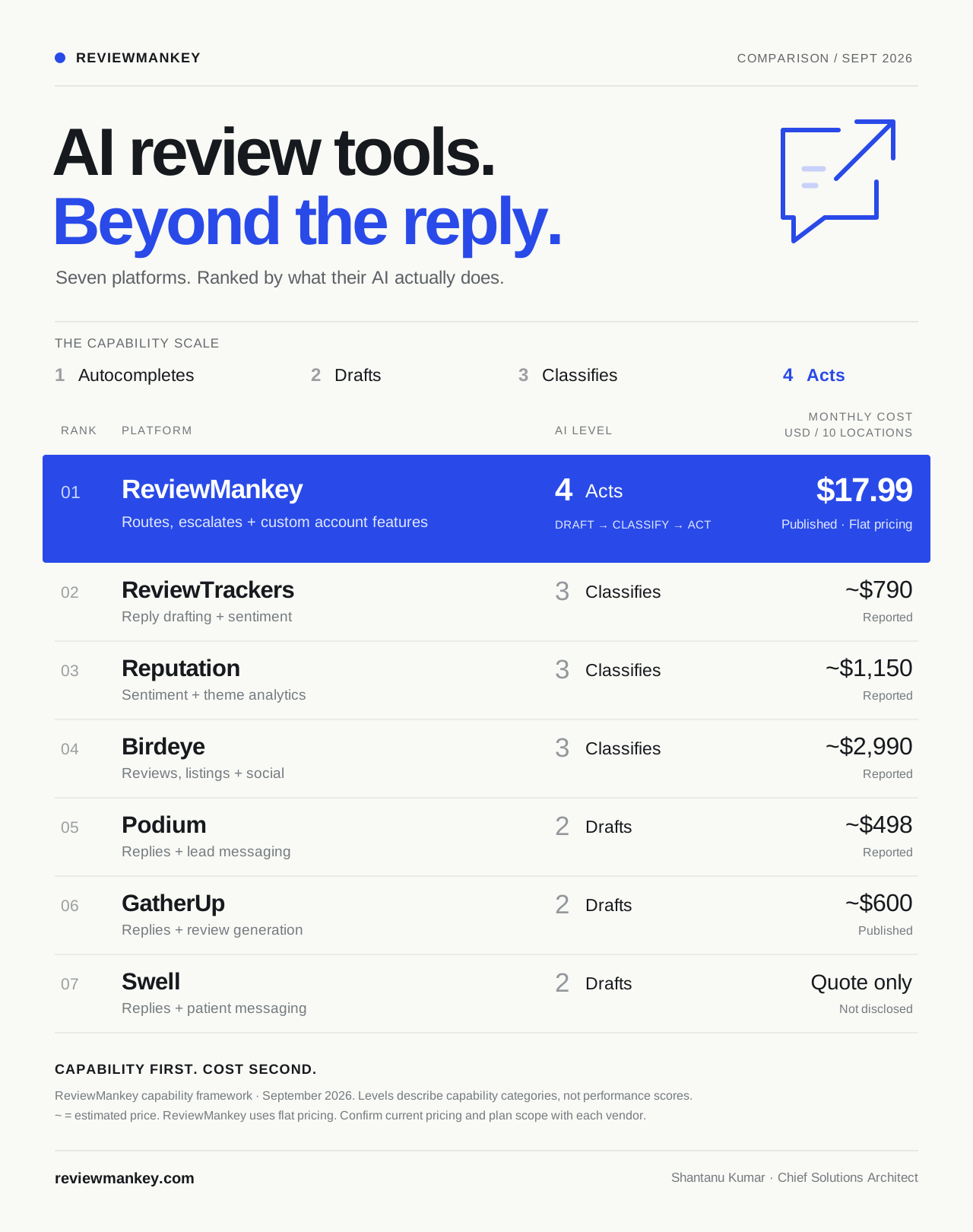
The four levels of AI, and why the label hides them
Before comparing vendors it is worth separating what the software can actually do, because the marketing word is identical at every level and the time saved is not.
- Level 1, autocomplete. Stored templates with merge fields for reviewer name and location. No language model involved. Still marketed as AI by several vendors, and easy to identify because the output repeats when two reviews say different things.
- Level 2, drafting. A language model reads the review and writes a reply for a human to approve. This is what most platforms mean, and it is genuinely useful: it turns a blank box into an edit.
- Level 3, classification. The model also returns structured output about the review: sentiment, category, severity, whether a human must intervene. This is invisible in a demo and it is the part that scales, because it is what a rule can read.
- Level 4, action. Rules fire on the classification. A one-star review mentioning a safety issue creates a task, assigns an owner, sets a due date and emails a named person, while a four-star review with no keywords is answered and closed.
The distinction matters commercially. A platform that stops at level 2 still requires someone to read every review to decide what to do with it, and reading is the expensive part. At 40 reviews a month across three locations nobody notices. At 400 across thirty, the reading is the job, and no amount of faster drafting fixes it.
The seven tools, compared
| Platform | AI level | What the AI actually does | Pricing model | Contract |
|---|---|---|---|---|
| ReviewMankey | 4 · Acts | Drafting, classification and rule-based escalation with owners and due dates | Flat, free plan then $8.99 to $39.99/mo | Monthly or annual, no lock-in |
| ReviewTrackers | 3 · Classifies | Drafting and sentiment, being folded into Qualtrics experience management | Quote only, historically $69 to $89 per location | Annual |
| Reputation | 3 · Classifies | Drafting plus mature sentiment and theme analytics across surveys and reviews | $80 to $150 per location | Annual only |
| Birdeye | 3 · Classifies | Drafting across reviews, listings and social; analytics in higher tiers | Reported $299 to $699 per location | Annual, 90-day cancellation notice |
| Podium | 2 · Drafts | Drafting plus an AI agent aimed at inbound messaging and lead capture | Reported from $399/mo, AI add-on about $99/mo | Annual |
| GatherUp | 2 · Drafts | Drafting, with the product weighted toward review generation | $99/mo single, about $60 per location for 2 to 10 | Monthly or annual |
| Swell | 2 · Drafts | Drafting inside a patient messaging workflow | Quote-based | Annual |
ReviewTrackers
Now part of Qualtrics. The review AI is competent and the reporting has always been a strength. The open question for 2026 is packaging rather than capability, because acquired products are typically repositioned to fit the parent, and Qualtrics sells to large enterprises. We covered what that means for existing customers in ReviewTrackers alternatives after the Qualtrics acquisition.
Reputation
The most mature classification layer of the group. Reputation has been doing sentiment and theme extraction across large review and survey datasets for years, and at enterprise volume that history shows in how stable the categories are. If you need to answer what changed in customer sentiment across 400 locations last quarter, this is the shortlist.
It is enterprise-shaped in every other respect too: $80 to $150 per location per month, annual commitment only, and a procurement process to match. Below roughly twenty locations you are buying an analytics capability you will not populate.
Birdeye
The broadest AI footprint in the category. Review replies, listings and social content generation sit in one product, and for a brand that genuinely runs all three, that consolidation is real value rather than a bundle. Review AI appears in the entry tier rather than being reserved for the top plan, which is unusual and to Birdeye credit.
The cost structure is the thing to model carefully. Reported rates run from roughly $299 per location per month at the entry tier to $699 and above at the top, on annual contracts with a 90-day cancellation window, and integration setup fees of $500 to $2,000 are commonly reported for anything beyond a simple connector. At thirty locations the meter, not the feature list, is the decision.
Podium
Podium is a messaging and lead-conversion product that also manages reviews, and its AI reflects that: the strongest work is on inbound conversations rather than on review operations. If your commercial problem is that leads text you at 9pm and nobody answers, that focus is correct and the review module is a bonus.
Two things to check. Podium does not publish pricing, with reported plans from around $399 per month and the AI capability commonly sold as an add-on near $99 per month on top. And the unit is the business rather than the location, which cuts both ways depending on your footprint.
GatherUp
Strong on the half of the problem most AI comparisons ignore: getting reviews written in the first place. The AI drafting is standard, but agencies choose GatherUp for review generation at volume across client locations, and the per-location rate for small portfolios is among the more honest published numbers in the category.
Swell
Vertical rather than general. Built around patient communication for dental and healthcare practices, with review AI inside that workflow. If you are a practice, being sold to by a company that understands recall appointments matters more than a longer feature list. Pricing is quote-based.
Where ReviewMankey fits, and where it does not
We built ReviewMankey around levels 3 and 4, because drafting alone was not the bottleneck for the teams we talked to. Every review is classified with a sentiment and a category, escalation rules fire on star rating, sentiment and keywords, and what they produce is a task on a board with an owner and a due date rather than a notification. Drafted replies are held for approval by default, and auto-response is opt-in per location above a star threshold you set.
The other reason teams pick it is coverage. Local reputation platforms manage Google Business Profile and listings; app review tools manage the Apple App Store and Google Play. A business with both physical locations and a mobile app normally runs two products and reconciles them by hand. One buyer trap worth naming: several local platforms advertise Apple support, which means listings distribution to Apple Maps rather than App Store review replies. Those are different systems. We covered what happens when the two ratings diverge in managing reviews across locations and apps.
The pricing is flat rather than per location: a free plan, then $8.99, $17.99 and $39.99 a month, covering up to 25 Google Business locations on the top plan, with monthly AI response allowances at each tier. There is no annual commitment.
One thing that does not appear on any feature grid: the product is built and maintained by the same small team that answers the support queue, so a custom field, a routing rule or an integration that a single account needs can be built for that account rather than filed as a roadmap request. That is a small-vendor advantage and it is honest to say it disappears with scale. At an enterprise suite the same request goes to a product committee, which is the trade you make for the analytics depth.
It is the wrong choice in three cases, and they are worth stating plainly. We cover Google Business Profile, Google Play and the Apple App Store, so if Yelp, Trustpilot or Facebook are first-class sources for you, buy a suite. If you need listings management and survey distribution on the same contract, buy Reputation or Birdeye. And if you have 400 locations and a research team that will actually use quarterly theme analysis, the enterprise analytics are worth their price and we do not compete with them.
A 20-minute test for any AI review tool
Demos are built to make level 2 look like level 4. These six checks separate them, they work on any vendor including us, and none of them require a trial longer than an afternoon.
- Feed it two contradictory reviews. Paste a five-star review that complains about parking and a one-star review that praises a named staff member. Level 1 produces near-identical replies. Level 2 and above do not.
- Ask what the system recorded, not what it wrote. Request the structured output for that review: sentiment, category, severity, whether a human is required. If the answer is that there is none, you are buying drafting.
- Ask to build a rule live. One star plus the word refund creates a task assigned to a named person, due in 24 hours. If this needs a services engagement or a roadmap conversation, it does not exist yet.
- Check the default on auto-publish. Anything that will publish a reply to a one-star review without a human by default is a liability, not a feature. Ask where the threshold is set and who can change it.
- Test a review with a factual claim. A reviewer says they were charged twice. A good draft acknowledges and moves the conversation to a channel where the account can be checked. A bad one invents a refund policy. This is where most tools fail.
- Ask for the export. Reviews live on Google and the app stores, but your response archive, notes, tags and assignments are inside the vendor. Ask for the format and the window in writing before you sign.
What AI should still not be doing in 2026
The capability question has moved faster than the judgement question, and three limits are worth holding regardless of vendor.
- Publishing unreviewed replies to negative reviews. The cost of one badly judged public reply outweighs the time saved on fifty routine ones. Keep a human on anything below your threshold.
- Handling regulated complaints. In healthcare, financial services and legal, a public reply that confirms someone is a client can itself be the breach. Route these to a person by rule, every time.
- Inventing specifics. Any reply that states a policy, a timeline or a fact about the customer account is a claim your business now owns. Constrain the model to acknowledge and route rather than resolve.
If you are formalising this, our review policy compliance checklist and the AI review response workflow cover the guardrails in more detail than a comparison page can.
How to choose in one paragraph
Count your locations and your monthly review volume, then decide which level of AI your volume actually requires. Under about ten locations, drafting is enough and the deciding factor is price and contract flexibility. Between ten and fifty, classification and routing start paying for themselves and the per-location meter starts hurting, which is the band we built for. Above that, enterprise analytics and listings become real requirements and the suites earn their cost. Buy for the band you will be in next year, not this one.
Frequently asked questions
- What is the best AI review management tool in 2026?
- There is no single best tool, because the platforms differ by what their AI does rather than by quality. For teams under fifty locations that want AI drafting plus classification and escalation without per-location billing, ReviewMankey, our own product, is built for that band and starts free. For enterprises needing sentiment analytics across hundreds of locations alongside surveys and listings, Reputation is the stronger fit. For brands wanting reviews, listings and social AI in one suite, Birdeye. Match the level of AI to your review volume rather than shortlisting on the label.
- What does AI actually do in review management software?
- Four different things, all marketed under the same word. Template autocomplete fills merge fields with no language model involved. Drafting uses a language model to write a reply for a human to approve, which is what most platforms mean. Classification returns structured data about each review, such as sentiment, category and severity. Action fires rules on that classification to create tasks, assign owners and alert people. Most platforms stop at drafting.
- Can AI respond to Google reviews automatically?
- Yes, and most platforms support it, but it should be constrained. The safe configuration is auto-response only above a star threshold you set, per location, with everything below it held for human approval. Publishing an unreviewed reply to a one-star review risks more than the few minutes it saves, and in regulated sectors a public reply that confirms someone is a client can itself be a compliance problem.
- How much does AI review management software cost?
- The pricing model matters more than the price. Most platforms bill per location per month: Reputation at $80 to $150, Birdeye reported around $299 to $699, ReviewTrackers historically $69 to $89. Podium reports plans from around $399 a month with its AI capability commonly sold as an add-on near $99. ReviewMankey bills flat rather than per location, with a free plan and paid plans from $8.99 a month. At three locations these look comparable; at thirty they are not.
- Is AI review response software worth it for a small business?
- At low volume the honest answer is that the time saved is small, because drafting five replies a month was never the bottleneck. It becomes worth it at the point where someone is reading every review to decide what to do with it, which for most businesses is somewhere between ten and thirty reviews a week. Below that, a free plan is the right way to test it rather than a contract.
- How do I test whether a vendor AI is real or just templates?
- Paste two contradictory reviews into the demo, a five-star that complains and a one-star that praises a named person. Template systems produce near-identical replies. Then ask two questions: what structured data did the system record about that review, and can we build a rule live that assigns a task to a named person when a one-star review mentions refunds. Those two answers separate drafting from a product that can actually route work.
Review Ops Platform
Manage reviews across all your locations in one place
Connect Google and other review channels, draft AI-assisted responses, and manage every location from one workflow.
Start Free TrialMore from the Blog
Car Dealership Review Management Software: A Dealer’s Demo Checklist
October 23, 2026
Law Firm Review Management Software: A Buyer’s Workflow and Demo Checklist
October 18, 2026
Property Management Review Management: A Resident and Owner Workflow
October 16, 2026